Mary Shelley squeezed my shoulder the louder the shouting grew.
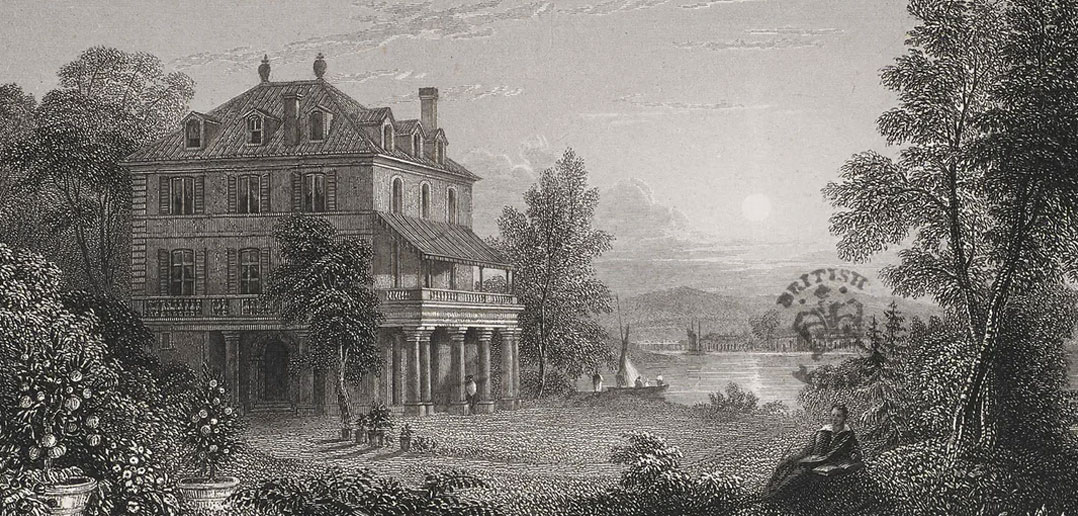
The arguing voices? There was Percy Shelley, Mary’s (soon-to-be) husband. Yelling over him was Claire Clairmont and Dr. John Polidori. And at the center of the drama was Lord Byron, the group’s host at Villa Diodati on Lake Geneva.
The demands, accusations, and insults between the four ramped up. And as they did, so too did Mary’s agitation, evidenced by her squeezing my shoulder harder and harder. Her upset briefly turned into my own.
Then she let go.
And when Mary Shelley let go, she stood before the group and shut them all up by reciting passages from her now-legendary Frankenstein. Then the show space went dark and the performers took their bows for the one-hour performance of Disremembrance: The Night Mary Shelley Wrote Frankenstein, a new (and still in-the-works) immersive play written and produced by Cati Brunell-Brutman and David Brunell-Brutman and directed by Virginia Logan.
The applause for all involved was happy and loud.
But I was disappointed. Not because the show lacked. Quite the opposite—I absolutely loved Disremembrance. My disappointment came from the show only being a single hour.
I wanted at least one more.
Immersive, Immersive, Immersive
I’m sick of the word “immersive” at this point.
It’s an abused marketing term, used to jack up ticket prices and pull in loyal (and sometimes controllingly fanatical) fans of shows like Sleep No More NYC and Life And Trust NYC.
There are, in fact, some new shows that are true to immersive form, like The Death of Rasputin. Others are bad gimmicks and cringe escape rooms.
And then there’s Disremembrance: The Night Mary Shelley Wrote Frankenstein, which very much has the stuff to become a true and great immersive theater show.
Disremembrance is dialogue-heavy and enthusiastically acted. The audience is largely ignored, seemingly unseen by the characters. Still, you’re in it. You stand around and within the performance as it’s happening. And you’ll need to eventually decide what characters and plots to follow and which to leave behind—the true hallmark of an immersive theater experience.
Who To Choose?
Disremembrance: The Night Mary Shelley Wrote Frankenstein was staged in the Cell Theatre as a “lab performance,” and despite it being a relatively small space, the six characters easily converged and separated on that reimagined dark and stormy night. Every character had a corner.
But who to choose?
I went with the posh and pompous Lord Byron (Michael John Improta), who performed the character as a kind of sexy, hedonistic, and aristocratic Truman Capote as he manifested in Feud. I don’t know much about the history of the real Lord Byron, but Improta’s take was wholly narcissistic: charming, seductive, arrogant, selfish, petulant, and cruel. No wonder I stuck with him—that’s the type of guy I typically chase in real life. Why break the cycle now?
I attended the show with friends, and they went after other characters. One didn’t want to leave the side of Claire Clairmont (Caitlin Evans). Another was taken in by the quiet and somber Mary Shelley (Chelsey Ng).
Luckily for me, Lord Byron’s bad behavior proved a locus for Percy Shelley (Nick Meyer) and Dr. John Polidori (Anthony DaSilva). There was plenty of nuanced tension between the three.
Haunting the performance was the “Shade” (Evelyn Chen), a woman dressed entirely in black. Her symbolism was clear enough: as a crawling, climbing, and wriggling wraith that drifted through different scenes, she seemingly reacted to (or caused) the emotions and tensions throughout the immersive theater show.
Was the Shade a ghost?
Yes, probably.
But I’d guess the Shade was more so a metaphorical one, much like the restless spirits in one of my all-time favorite movies, Guillermo del Toro’s Crimson Peak. Funny enough, the Shade looked an awful lot like the ghost of Edith’s mother from that very movie, a fact I smiled to myself over when first she appeared.
The Moments We “Live For”
And then there were those moments we “live for,” as one of my attending friends said.
They are the little interactive touches when characters break the fourth wall and reach out to the audience in some way.
During my experience, Lord Byron chose two audience members to recite poetry to, and then gave them the handwritten verses as keepsakes. (Full admission: I was annoyed and jealous I wasn’t selected.)
But I did have my small Mary Shelley interaction at the show’s climax. At first I wasn’t sure if the performer was gently pushing me out of the way for needed acting space. This happens all too often in immersive theater shows; I mentioned something similar in my piece describing the Tim Jones/Malcolm 1-on-1 encounter from Sleep No More NYC.
But that didn’t happen in Disremembrance.
The performer Chelsey Ng wasn’t shooing me out of the way.
The character Mary Shelley was having a moment with me.
And yes, as Mary’s grip tightened on my shoulder, I got the immersive theater warm-and-fuzzies we “live for” in these shows.
Praise Not Offered Lightly
Disremembrance only performed a small handful of lab presentations, starting around Halloween and ending in early November.
I’m disappointed I didn’t see more of them, especially since the cost of entry was only $40. The cost was far less than the then-steep $85 I paid for a weekday visit to Sleep No More NYC in 2012. Ah, memories.
I truly hope Disremembrance: The Night Mary Shelley Wrote Frankenstein goes the distance and finds its footing as a full-scale immersive theater performance. It already has strong bones, judging by my brief viewing of a single hour-long sampling.
And that’s not just me saying that.
When I met up with my fellow attendees after the show was over, everyone expressed how much they enjoyed it and wished there was more. And trust me when I say two of those voices do not offer praise lightly.
As for my own praise, I hope this review can help in some small way to push Disremembrance: The Night Mary Shelley Wrote Frankenstein a little bit closer toward a fully realized future.
Because I think it could truly be something magical.