As an immersive theater show, The Death of Rasputin should not work.
No masks. No loops.
But talking? Yes, there’s that. Laughter, even.
And yet, The Death of Rasputin works well. Quite well, actually.
But I didn’t walk away from The Death of Rasputin comparing it to its likely candidate—Punchdrunk’s Sleep No More NYC. Instead, I kept thinking about Third Rail’s Then She Fell, the Brooklyn-based Alice in Wonderland immersive show that ran from 2012 to 2020. Like Then She Fell, The Death of Rasputin extracted artistic and atmospheric DNA from Punchdrunk, but all-in-all, the performance is its own unique vision and experience.
The show’s core narrative is clear enough:
We’re immersed in 1916 Petrograd. The House of Romanov is about to take its last breath. The proletariat are ready to rise up. And Grigori Rasputin holds complete sway over the decadent and indulgent Czar and Czarina.
Because The Death of Rasputin is an immersive theater experience, it’s impossible to see the entire show in one visit. So do not waste the show’s 75-minute runtime. Choose one of the show’s 10 characters and do your best to follow the performance to its conclusion. You can’t go wrong with any character you choose, since they’re all lively and rich.
Grit, Hard Work, And Determination
The Death of Rasputin takes place within an impressive show space.
The show’s production company, Artemis is Burning, very much has the scrappy, roll-up-your-sleeves vibe of an art collective. Excellent, because one of the key ingredients in transforming Governors Island’s Arts Center into a centuries-old Petrograd was grit, hard work, and determination by all those involved.
One of the hurdles of transforming the space was, well, the space itself. The Arts Center is a historic landmark, so no permanent alterations were allowed. Everything that goes up must cleanly come down. This was made possible through donations, volunteer work, and one specific angel investor who backed the show.
I was invited on a behind-the-scenes tour of The Death of Rasputin by friend and unofficial benefactor Yale Zhang, during which co-director Ashley Brett Chipman and Kelly Bartnik (the original Bald Witch from both Sleep No More Boston and Sleep No More NYC) guided us through the set. Both Chipman and Bartnik brought up the stresses of trying to build a realistic immersive experience within a state of impermanence.
One detail that stood out was Bartnik’s mentioning of a volunteer bringing tree limbs down from upstate New York to fill out the Siberia set. Another was the use of many props repurposed from Sleep No More NYC, such as the central altar in Duncan’s mausoleum. And the cast was originally 16 characters, then reduced to 8, and then brought back up to 10 (Petra and Fyodor).
And the sets?
Along with the frigid Siberian wastes, we see the royal suites of the Czar and Czarina, Rasputin’s dark and brooding cabin, and a lively and bright tavern where the peasants gather. Scattered throughout are hidden details and secret passages.
Nothing But Charisma
Maybe it’s the show’s scrappy origin story that gives it the heart and soul it has.
That—and the performances.
The cast of The Death of Rasputin is nothing but charisma. I’ve seen the show four times, and spent a fair bit of time with Dread (Louis Butelli), Iliodor (Tim Creavin), Felix (Adam Griffith), Fyodor (Cashton Rehklau) and Rasputin himself (Jake Ryan Lozano). Some characters draw more audience members than others. Thus, they get crowded; Rasputin and Felix are two examples.
Personally, my favorite has been Tim Creavin’s Iliodor. He’s a quieter and subtler character, and has a wonderful scene where he holds a church service and anoints his followers with holy oil. These are what I hunt for in any immersive theater show. Not the loud and bombastic, but the quieter and intimate moments that make the show a memorable personal experience.
This brings me to my second favorite character—Fyodor. Cashton Rehklau’s performance is lively and sweet, but there’s a sad and troubled undercurrent that dogs him until the show’s conclusion.
Very Much Alive
The Death of Rasputin forgoes masks, much like Then She Fell did years ago.
This cuts down on production costs, but it also works to the show’s advantage. The Death of Rasputin is no supernatural journey into a dark and surreal dreamscape. It’s very much alive and we, as the audience, are alive in it. We’re simply there, present and consciously acknowledged by the performers through the entirety of the show.
Dread scolds us for our incompetence. The Czarina demands our servitude. Fyodor and Katarina rile us up into joining their underclass revolution. And Rasputin seduces us into his mystical cult.
That said, the show isn’t flawless.
Remember the set’s need for impermanence? This causes quite a bit of sound bleed between scenes. Sometimes it works, such as the pleb uprising heard downstairs while the Russian royals live their opulent lives upstairs.
Other times it doesn’t work. I’ve walked into competing scenes, where there’s overlapping dialogue scrambling for your attention (mine, anyway). It doesn’t happen a lot, and the performers are skilled enough at holding your focus. But it’s worth noting.
There’s also a lot of audience participation—dancing, prayer, military planning, rebel uprising, etc.
Your enjoyment of this is going to be subjective. I am not in love with it; I usually want to be left alone unless pulled for a coveted 1-on-1 encounter. But others I’ve talked to are all for the audience participation.
It’s easy enough to stay out of it, though.
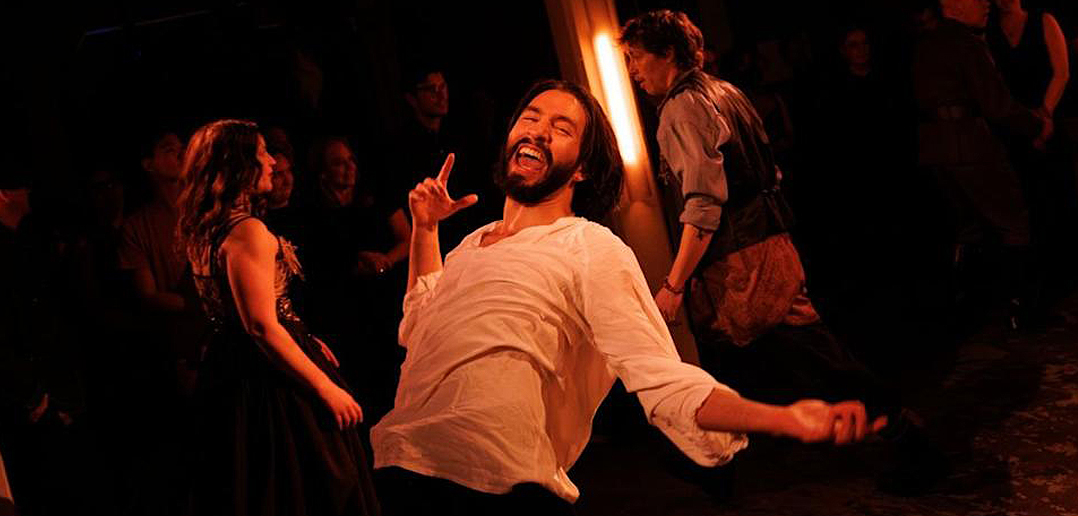
One of the show’s centerpiece scenes, an ecstatic prayer circle led by Rasputin in the dark wilds of Siberia, encourages as many audience members as possible to participate in a ritualistic dance. I opted out, but very much enjoyed watching the ritual and Jake Ryan Lozano’s ecstatic guidance of it.
The finale of the show is a truly wonderful ballroom spectacle, and I looked forward to seeing it every time I returned.
Time, though. Time is an important consideration with The Death of Rasputin.
I don’t know how many more times there will be, since The Death of Rasputin is operating within a rather short scheduling window. The show is currently running until June 29, so make sure you see it before it is gone forever.